Baseball Analytics Aren't Broken, They Just Need Updating
What I Learned at SABR

Certain stats from Cleveland Guardians pitcher Gavin Williams would have you believe he’s not very good. Last season, Williams had the biggest negative differential in Fielding Independent Pitching (FIP) vs Earned Run Average (ERA) among qualifiers last season (4.39 FIP vs 3.06 ERA).
FIP was supposed to be a way for analysts to isolate the outcomes a pitcher has complete control over: strikeouts, walks, hit-by-pitches and home runs. Balls in play are not entirely within a pitcher’s control, and including such data in a stat like ERA adds randomness unnecessarily. It also suggests big differences will mean regression is coming, so in the case of Gavin Williams, this upcoming season could spell problems.
However, though Williams did walk a lot of hitters last season, his stuff did help him with a 70th percentile groundball rate in part because of an increasing rate of pitches getting topped. He did it with a sinker and breaking pitches with more of a downhill trajectory, complementing his fastball and forcing more weak contact. If you look at his pitch movement visualization from Baseball Savant, you’ll see his curveball breaks down more than average and his 4-seamer breaks toward third base more than average:
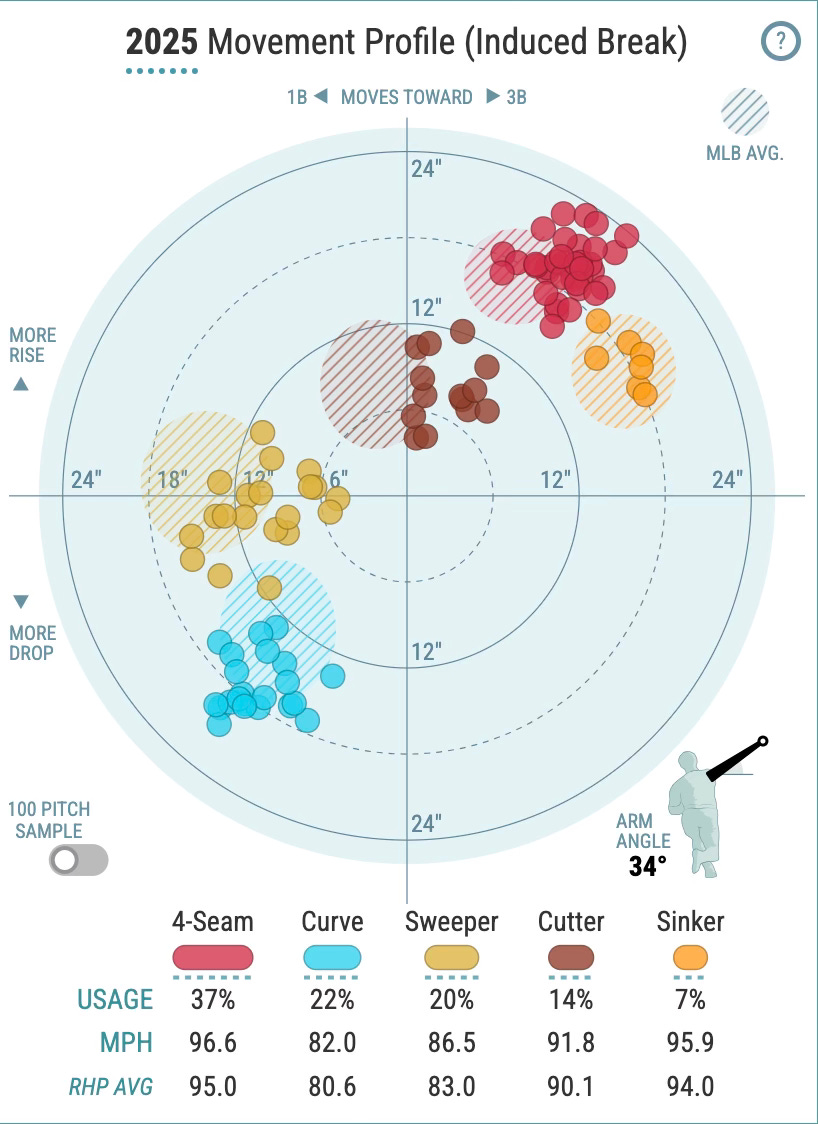
Had we only looked at his FIP, we would have had an incomplete analysis. Pitch quality, and more importantly pitch shape, can impact what the ball does in play, and that is a direct reflection of Williams.
One of Many Lessons at SABR
FIP being overrated was one of many lessons I learned while attending my first SABR Conference. That idea came from the fantasy baseball panel comprised of Baseball HQ’s Dave Adler, THE BAT X creator Derek Carty, Rotowire columnist Jason Collette and The Athletic’s Eno Sarris and Derek VanRiper.

The biggest lesson I learned is I want to attend more SABR Conferences, and not just as an observer. One big reason is witnessing how baseball's sharpest minds aren't abandoning analytics, they're stress-testing the old ones and building better ones.
Take evaluating baseball managers. It's always felt like if a team exceeded preseason expectations, the manager gets the credit. If they don't, that leader gets fired.
But, that evaluation process should be more robust. Vince Gennaro has been a consultant to Major League Baseball teams, an analytics enthusiast and a pioneer in defining transformative leadership.
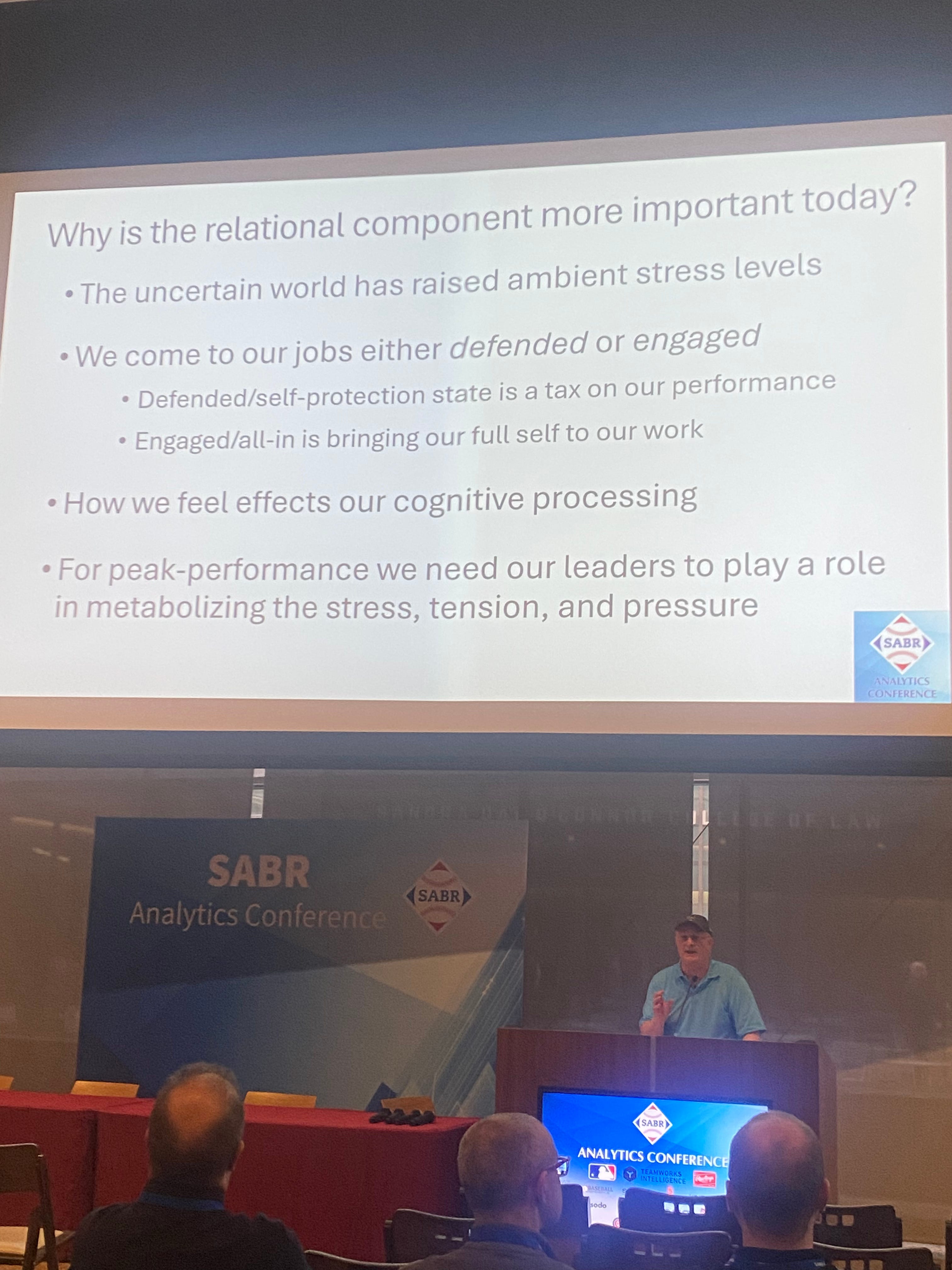
As he put it, analytics culture favors discrete, measurable and isolatable solutions. It’s one of the reasons why baseball embraced the analytics revolution more readily than other sports because all “plays” are largely discrete from each other, though we are learning that’s actually less true than realized.
But, when it comes to analyzing how good a manager is, the outsider is going to have it challenging because of interdependency. What are the causes and effects of a manager making personnel changes or in-game decisions well beyond that one inning or game? A macroscopic view of wins and wins over expectation will only tell us so much.
So the question then is, are there statistics that can help us quantify manager effectiveness? One idea bandied about is looking at slumps. Every player and ballclub will endure a slump; but, the duration may be shortened by proper managing and coaching. Playing consistently is a green flag.
Another way to look at that dynamic is actually at the other extreme: winning streaks may be an overrated sign. Last season, the longest winning streak belonged to the Milwaukee Brewers earning 14-straight victories. However, they were swept in the National League Championship Series to the eventual-champion Los Angeles Dodgers. A winning streak is a sign you have potential, but it may not mean you have the consistency required to be excellent. By the way, the Dodgers’ longest winning streak last season was eight.
“At the end of the day, it’s about if the players feel good about the work they’re doing,” said Gennaro.
Another Frontier
Returning to the fantasy baseball panel, there are a lot of sophisticated and powerful projection systems out there: ZiPS, Steamer, THE BAT X, ATC, OOPSY, etc.
But, when is it ok to go against what the consensus of these projections might be for a player? And no, it’s not “the human element” like “heart” or “will”, no one is going to know that more than anyone else, so don’t get me started.
What you’re looking for is some context that causes unpredictability. Think about players getting more reps for the first time like Ernie Clement, landing in a new environment like Garrett Crochet, or still developing like Nick Kurtz. Looking at track records of new coaches and analyzing similar situations in baseball history will add layers to these analyses and give analytics a new dimension.
Key Takeaway
Analytics is a way of thinking more than it is new ways of playing sports or strategies that go against tradition. Thinking can include changing your mind with new information or broadening your horizons because you now can. While SABR discussed a lot of baseball issues of our time like pitching workload and tipping pitches based upon fielder positioning, the general theme was clear: analytics has new frontiers that can be reached if we reconsider what got us here in the first place.